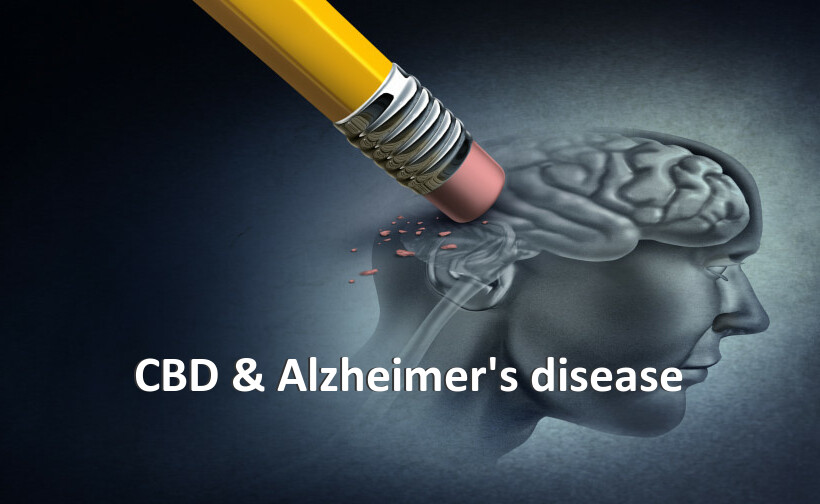
Alzheimer's disease and CBD
Alzheimer's disease is a neurodegenerative disease that affects nearly 1 million people in France. Worldwide, 57 million people were living with dementia in 2021 (WHO), Alzheimer's disease accounting for 60 to 70% of cases. It is estimated that by 2040, France will have more than 2 million patients. Slow and insidious, it is the most common form of dementia in people over 65.
Alzheimer's disease was first described in 1906 by the German psychiatrist Alois Alzheimer. Affected patients gradually lose neurons, which gradually and irremediably leads to a loss of mental functions. The first symptoms are usually the loss of memories (amnesia). Initially, patients can no longer remember recent events; short-term memory is affected. Earlier memories are still preserved for the time being. Over time, the disappearance of neurons from other areas of the brain results in more pronounced cognitive impairment leading to confusion, mood and language disorders, and aggression.
The prevalence of the disease varies greatly with age: about 1% of people aged 65 to 70 are affected, 20% of those aged 85 to 90, and 40% of people over 90.
The Brain
Alzheimer's disease causes the progressive destruction of neurons by lesions that spread throughout the brain. These lesions are due to an accumulation of abnormal proteins:
- Beta-amyloid protein => amyloid plaques
- Tau protein => neurofibrillary degeneration
The first area affected is the hippocampus, the seat of memory, then Alzheimer's disease will extend to the frontal and temporal-parietal associative cortices. As the disease progresses, the disorders will worsen until they become extremely severe, ultimately leading to death.
Diagnosis
The diagnosis is based on several points:
- A medical interview
- Neuropsychological tests
- Brain imaging
- A neurological examination
The treatment
There is currently no cure for Alzheimer's disease. Available drugs can only relieve some symptoms or, for some recent ones, slightly slow the disease at an early stage. This is why an early diagnosis matters: it makes it possible to put in place, as soon as possible, a strategy to improve living conditions:
- Cognitive stimulation
- Speech and Language Therapy
- Physiotherapy
- Stimulating therapies
CBD and Alzheimer's disease
In preclinical work (on cells and animals), researchers at the University of La Sapienza in Rome reported that CBD reduced inflammation linked to beta-amyloid protein and was associated with the formation of new neurons in the hippocampus, the site of memory. They concluded that further research is needed. These results cannot be transposed to humans and do not allow any conclusion.
CBD is not a medicine and is not a treatment for Alzheimer's disease. For any question about memory or about the care of a loved one, ask a doctor for advice.