Mad cow disease
In the 1990s, one of the biggest health scandals in Europe broke out, with the discovery of numerous cases of bovine spongiform encephalopathy (BSE), more commonly known as mad cow disease, in cattle. This disease causes a degeneration of the nervous system in cows and is fatal and transmissible to humans.
The disease
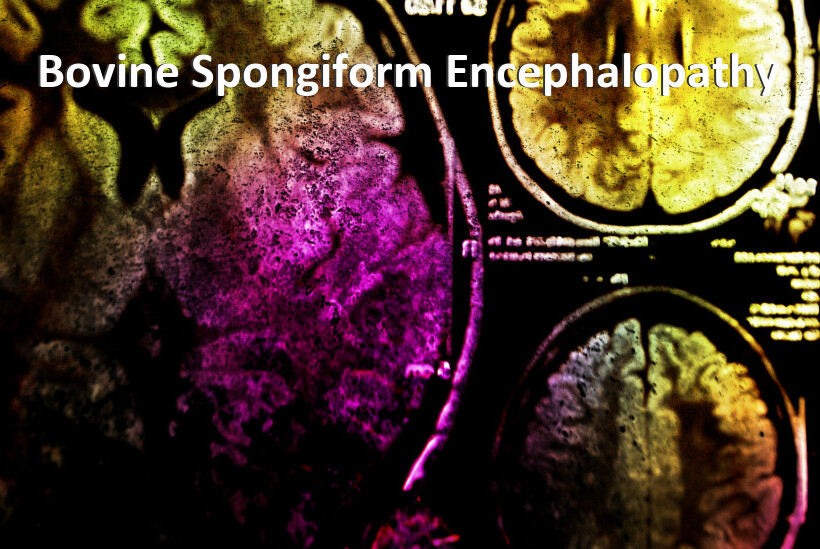
Bovine spongiform encephalopathy (BSE) is a disease caused by a prion (a pathogen made up of a protein), which will cause a degenerative infection of the central nervous system, leading to the death of the infected subject. The prion spreads in the brains of cattle, giving them the appearance of a Swiss cheese, and eventually destroys them. Symptoms usually appear around the fifth year after infection. The cow's behaviour changes and it becomes hypersensitive to various stimuli such as noise, touch or light. The animal isolates itself from other animals, and gradually its state of health deteriorates, with significant problems of locomotion, and finally death. The evolution of BSE varies from one week to one year, with each phase of the disease varying from one cow to another.
The origins of the disease
The origin of the disease is not really known, and several hypotheses have been put forward. However, it would appear that the epidemic is due to an interspecific transmission of a disease similar to scrapie in sheep. The spread of the infectious agent is thought to be due to the feed offered to cattle. For years, slaughterhouse waste, carcasses of dead animals unfit for human consumption were crushed, heated and processed into meal. These flours, extremely rich in protein, were then incorporated into animal feed. Scientists believe that the prion appeared at this time, and that the flours were used as vectors to contaminate herds. As more and more animals became infected with BSE, a new disease appeared in humans, a variant of Creutzfeldt-Jakob disease (vCJD), with effects very similar to those of BSE.
CBD and bovine spongiform encephalopathy
CBD is a molecule coming from industrial hemp (Cannabis Sativa). Its possible effects are the subject of much research, mostly preclinical (on cells or animals).
Research from the French National Centre for Scientific Research (CNRS) in Valbonne, France, explored the effects of CBD on prion diseases in the laboratory: in infected cells, CBD limited the accumulation of the prion. These preclinical results cannot be transposed to humans or animals and do not allow any conclusion.
CBD is not a medicine and does not protect against prion diseases. For any health question, ask a doctor (or a veterinarian for animals).