What is homeostasis?
Homeostasis is a process that allows the body to maintain its internal balance, and therefore good health, while the external environment constantly changes. In humans and other mammals, a large number of processes are permanently and jointly at work to keep the body functioning properly. This is a complex task, because the body faces various changing external factors, such as temperature, stressors, diet, and so on.
The most telling example is outdoor temperature. When it is very cold, the body has to work to maintain its temperature and avoid hypothermia. Various receptors signal to the brain that it is cold and that it needs to act. In response, the brain triggers vasoconstriction and a rise in blood pressure, which reduces heat loss: homeostasis is maintained, and the system has done its job.
During a period of intense stress that generates anxiety, for example an exam or a job interview, the body reacts by releasing certain hormones, including adrenaline, which raise the heart rate and blood pressure, as well as body temperature and alertness levels, in response to the situation.
These examples show how your body's internal parameters can fluctuate in reaction to external events. Five million years of evolution have enabled the human body to manage external events efficiently in order to keep functioning optimally.
The endocannabinoid system
The endocannabinoid system (ECS) is a system found in all mammals, discovered in the 1980s. It has been the subject of countless studies, as its functioning and its effects on the body are so central. Studies have identified receptors, ligands, and enzymes associated with the endocannabinoid system throughout the body, from the nervous system to the immune and digestive systems, as well as in tissues and many other parts of the body. The ECS plays a fundamental role in the body's physiology, because it helps the other systems maintain an essential state of balance: homeostasis.
Research findings suggest that the endocannabinoid system is involved in regulating inflammation, appetite, pain, anxiety, metabolism, and more.
Its structure is as follows, with 3 main components:
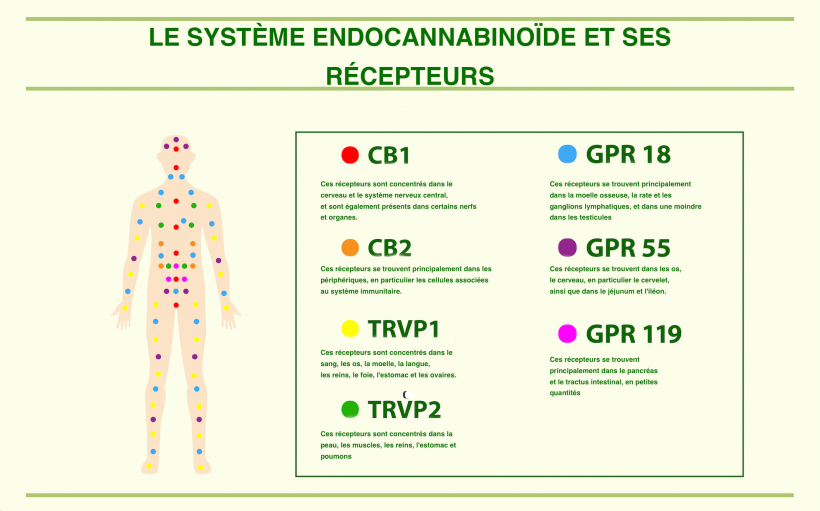
- Cannabinoid receptors found throughout the body, including the brain and the nervous axis, but also on many cells of the immune system. These receptors are called CB1 and CB2, TRPV 1 and 2, as well as GPR 18, 55, and 119.
- In the brain, the ECS synthesizes endocannabinoids such as anandamide, which bind to the cannabinoid receptors mentioned above.
- Certain enzymes break down the endocannabinoids once they have been used.
The endocannabinoid system is therefore a signaling system that plays an important role in regulating the balance of the human body, and in all vertebrates as well. It is involved in a great many functions, such as neural development and plasticity, appetite regulation, immune function, metabolism and energy regulation, cognition, pain, memory, sleep, and more.
Its dysregulation is thus associated with pathophysiological conditions. Since the early 2000s, Dr. Ethan Russo, a researcher specializing in medical cannabis, has developed the concept of "cannabinoid deficiency." According to this hypothesis, published in 2004 and revisited in 2016, certain conditions such as migraine, fibromyalgia, or irritable bowel syndrome could be linked to a deficiency of the endocannabinoid system; it has not been proven. Studies have shown that in certain diseases, such as cancers, intestinal or heart diseases, chronic pain, and post-traumatic stress, the ECS was altered. These observations do not show that taking CBD (cannabidiol) or other hemp cannabinoids (Cannabis Sativa) corrects such an imbalance: the "cannabinoid deficiency" hypothesis remains debated, and nothing allows us to say that CBD improves symptoms or slows a disease. CBD is not a medicine; if you have a medical condition, ask your doctor for advice.
CBD
Cannabidiol (CBD) is a substance derived from hemp (Cannabis Sativa), found in abundance in the flowers, not in the seeds of the plant. It is the phytocannabinoid (a cannabinoid from the plant) with the highest content in this variety. In the Cannabis Indica variety, THC (psychoactive and illegal in France) is predominant. Its effects on stress, anxiety, inflammation, pain, or sleep are being studied, without allowing any conclusion to date. CBD does not cause dependence, unlike THC-rich recreational cannabis, and does not produce narcotic effects.
The difference between CBD and THC
For many years, cannabis was associated only with THC, a phytocannabinoid with psychoactive effects on the body. The Cannabis Indica variety is the one used by illegal recreational cannabis distribution networks, and it is prohibited by law. Yet the cannabis plant contains more than a hundred cannabinoids, THC included (125 identified by Radwan et al., Molecules, 2021). The variety used to produce CBD (cannabidiol), or hemp intended for other uses, is Cannabis Sativa, whose THC content is close to zero and must be below 0.3% (French decree (arrêté) of December 30, 2021). Products sold must always comply with this threshold. CBD does not have the psychoactive effects of THC, but that does not mean it is free of side effects (drowsiness, digestive issues, drug interactions).
CBD and homeostasis
In the laboratory, CBD acts on several targets: it can slow down the activity of the FAAH enzyme, which breaks down anandamide (an endocannabinoid produced by the body itself), and bind to TRPV1 receptors, which are involved in regulating temperature, pain, and inflammation. These mechanisms, observed mainly in cells or in animals, do not allow us to say that CBD helps maintain homeostasis or good health in humans.
Which CBD products are permitted?
There are many CBD products, but none can claim to "support" the endocannabinoid system: no health claim is authorized for CBD. In France, CBD oils for oral use, such as capsules and gummies, are foodstuffs that may not be sold (EU Novel Food Regulation (EU) 2015/2283, French Ministry of Agriculture press release of May 20, 2026); the sale of flowers and leaves from authorized varieties is permitted. As for the "entourage effect" attributed to broad-spectrum products (CBG, CBN, terpenes, flavonoids), it remains an unproven hypothesis.